
Developing a new financial product: Lifelong Income
—
Engagement length: Intermittent across 3 years (FY23 to FY26)
Sector: Financial service
Team: Senior Service Designer, Product Managers, Investment teams, Actuarial Analyst, Business Analyst, Legal teams, Risks teams.
Object of design: Financial Product Design, Product proposition, distribution strategy, experience design, and member research to support product development.
—
Lifelong Income is a guaranteed retirement income product designed to give members the confidence to spend in retirement. Three years of service design work built the evidence that moved it from internal assumption to a $20m+ board-approved business case.
How service design moved a $20+m retirement product from internal assumption to board approval.
Australia's retirees are living longer and spending less. The fund wanted to build something that solved for both.
Australian retirees are systematically underspending in retirement. Our retired memebers are drawing only the legal minimum from their super out of fear of running out. Regulators are pushing super funds to develop more sophisticated income solutions to deliver better retirements for retirees, and competitors are beginning to develop similar products.
The product they conceived was Lifelong Income: an income stream guaranteed for life, designed to sit alongside the existing Retirement Income Account and give members the confidence to actually spend. The strategic logic was clear. What wasn't clear was whether members would commit to buying it.
The category made this harder than it sounds.
Lifetime income products have existed for decades. They have always been difficult to take up, not because they're bad products, but because they're hard to understand, hard for advisers to sell, and hard for members to commit to. The perception that dying early means losing your money has created hesitancy that product design alone hasn't resolved.
The board wasn't just asking "will members want this?" They were asking, "Given how hard this category is to crack, what gives us confidence this will be different?"
The team had a strong product. They needed evidence the market would meet it.
The product team had spent years on strong foundations: actuarial modelling, product structure, investment options, legal consultation. What they hadn't established was a precise customer value proposition, a clear target market, or a distribution model that could reach members at scale.
Each time the project required significant investment, leadership returned to the same question: how confident are we that members will actually follow through? That's the question I was brought back to answer, across three engagements over three years.
Problem to solve:
How might we prove that members' desire for a
guaranteed retirement income product would translate into real commitment to buy?
Approach
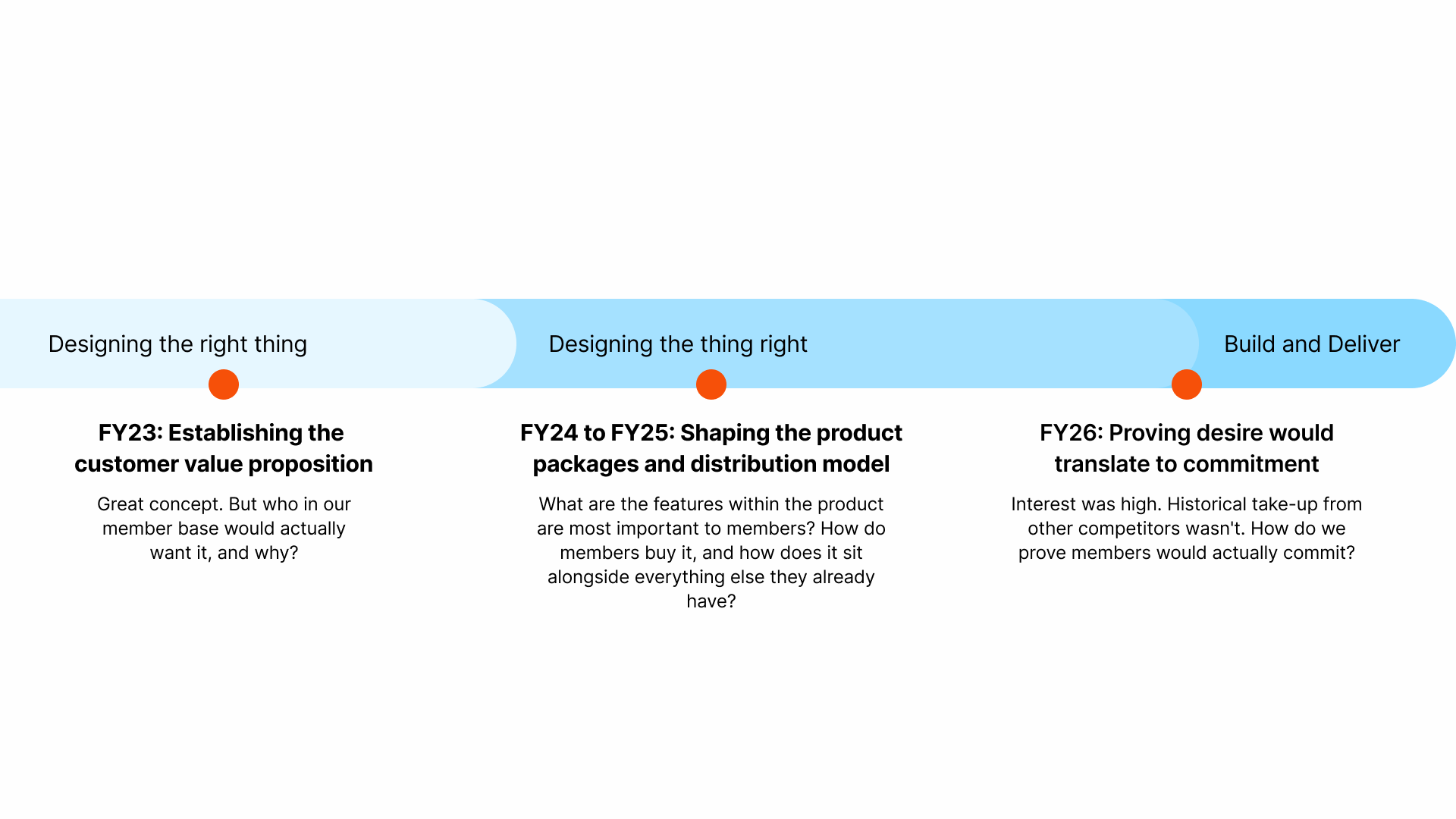
Project Timeline: Intermittent across 3 years (FY23 to FY26)
Phase 1: Establishing the customer value proposition (FY23)
Previous research had jumped to concept testing without first establishing why members would want the product. I reoriented the brief around who this was for, why they'd want it, and what it meant to them.
Conducted 24 in-depth member interviews across 2 rounds, 5 rounds of prototype iteration, 4 adviser SME interviews, international benchmarking, and a full synthesis of existing organisational research.
Participants spanned full pensioners to high-net-worth self-funded retirees aged 61 to 75, drawn from multiple funds to avoid skewing findings.
The key reframing: members connected with the product when it was framed as permission to spend, rather than as a financial instrument. That shift cascaded through the CVP, product language, and adviser conversations three years later.
Produced: a customer value proposition, member archetypes, target market segmentation, and a hypothesised distribution model.
Phase 2: Shaping the product packages and distribution model (FY24 to FY25)
Most members wouldn't reach the product through financial advice. It needed a direct path.
Defined the member outcomes and income goals the Retirement Income Plans needed to achieve, giving the actuarial and investment teams a member-grounded brief before modelling began.
Designed the digital purchase experience and coordinated external legal review to confirm it didn't constitute personal financial advice, clearing the self-service channel.
Created the first end-to-end strategic roadmap of the full retirement product suite for exec and board visibility.
Validated at scale through the Retirement Study (1,512 respondents): 78% could navigate and choose a plan, 84% felt confident in their choice, and 61% chose a plan including Lifelong Income (board submission modelled this conservatively at 40%).
Phase 3: Proving desire would translate to commitment (FY26)
Ran three parallel research and design streams to move beyond stated preference into behavioural evidence.
Designed and facilitated multiple focus groups with around 40 participants, built around a mock product brochure I developed to give members enough product comprehension to answer specific feature questions around investment options and income type. Outputs fed directly into finalising the product spec and informed negotiations with an insurance partner.
Designed and ran an adviser mock sale programme: 12 member-like participants paired with advisers in live simulated appointments. Advisers came in uncertain and left as advocates, able to articulate why the product was a stronger offer than other annuity products they'd sold before.
Co-designed the digital purchase flow with a UX designer.
The finding that reshaped the distribution strategy: commitment required knowledge maturity and timing maturity before members were ready to engage with an allocation decision. This became the maturity model at the heart of the launch strategy.
This work resulted in
A customer value proposition, target market definition, and member archetypes that gave the project its strategic foundation
Retirement Income Plans: three member-legible product packages validated with over 1,500 survey respondents
A legal-cleared digital purchase experience opening the self-service distribution channel
A maturity model defining the conditions members need before committing to purchase
A phased strategic roadmap used in exec and board conversations across two financial years
A board-approved business case securing $20m+ in funding to build and launch the product
The impact of this work
Sustained Board and Executive Confidence
Secured board approval for $20m+ in funding, underpinned by three years of sustained member evidence that gave executives the confidence to back the project at every investment gate.
Multi-Year Roadmap and Build Sequencing
Mapped the full retirement product suite and sequenced the multi-year build dependencies, including the technical capability to split member balances across two products and the logic to suggest the right proportion, giving the board a credible roadmap behind the submission.
Advisers Convinced by the Product, Not Just the Process
Shifted adviser sentiment from hesitancy to advocacy. A product they would previously have been reluctant to recommend is now one they're willing to sell.
Research-Grounded Decisions That Earned CEO Confidence
Resolved CEO-level uncertainty about product feature decisions and the insurance partner arrangement. Following the December 2025 research presentation, the CEO confirmed they were comfortable with the direction and that the project should continue.